The Parasite–Cancer Connection
Cancer and Parasites
What the research says about hidden infections and the tumor microenvironment
Cancer and parasites are two topics almost never discussed together — yet some of the strongest evidence in cancer science is built on exactly that connection. The International Agency for Research on Cancer classifies Schistosoma haematobium as a Group 1 carcinogen for bladder cancer, and liver flukes such as Opisthorchis viverrini for cholangiocarcinoma. The mechanisms — chronic inflammation, immune modulation, molecular mimicry, and cell-signaling disruption — are the same forces explored across The Parasite-Cancer Connection by James Young, RN. This is educational information, not medical advice; the aim is to inform the questions you bring to your own care, not to diagnose or treat anything.
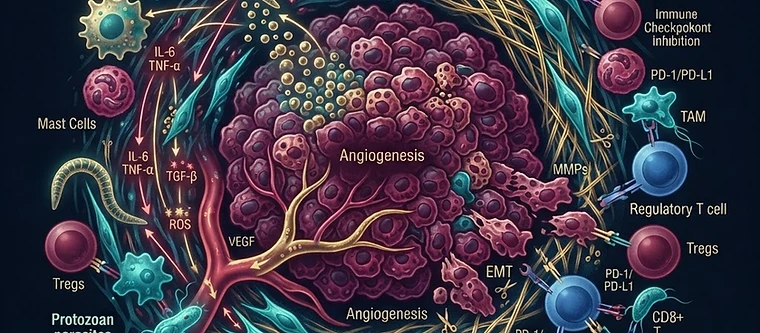
The Science
How parasites and cancer biology intersect
Cancer is not a single event; it is the result of cellular processes going wrong over time, and chronic inflammation is one of the hallmarks that fuel it. Parasites are among the most potent chronic inflammatory drivers in the human body. They damage tissue, deplete nutrients, alter the microbiome, modulate or suppress immune responses, and in some cases produce compounds that interfere with host-cell signaling. These are exactly the conditions in which damaged, mutating cells can gain a foothold. The link between cancer and parasites is not speculation — for several parasites it is established, classified science.
Beyond the proven carcinogens, researchers are investigating broader questions: how Toxoplasma gondii interacts with brain tumor biology, how schistosomiasis-associated inflammation may contribute to other cancers, and how the chronic immune disruption caused by long-term parasitic infection shapes the tumor microenvironment. The Parasite-Cancer Connection lays out the proven connections, grades the strength of each claim, and separates documented science from emerging hypotheses — so you understand what the research actually shows and what to ask your doctor. This is educational information, not medical advice.
Questions and clinical context to discuss with your care team
These points are provided as educational context for informed discussion with qualified healthcare professionals. They are not evidence that a parasite caused a cancer or other condition.
- A cancer diagnosis and questions about what contributed to it
- History of travel, water exposure, or parasitic infection before diagnosis
- Chronic inflammation markers with no clear cause
- Persistent digestive, liver, or bladder issues alongside a cancer diagnosis
- A desire to understand the infection-and-inflammation side of cancer biology
- Looking for informed questions to bring to your oncology team
What this book covers
- Why chronic inflammation is a recognized hallmark of cancer.
- Schistosoma haematobium and bladder cancer — an IARC Group 1 carcinogen.
- Liver flukes (Opisthorchis, Clonorchis) and cholangiocarcinoma.
- How immune modulation and molecular mimicry shape the tumor microenvironment.
- Emerging questions about Toxoplasma gondii and brain tumor biology.
- The difference between proven parasite-cancer links and emerging hypotheses.
Related Research
Read the supporting research
These focused articles expand on specific mechanisms, diagnostic distinctions, and documented research related to this topic.
Common Questions
Cancer and Parasites — your questions answered
Stop guessing. Get the research.
The Parasite-Disease Connection by James Young, RN walks you through the evidence, the mechanisms, and the conversations to have with your doctor — so you can stop chasing symptoms and start asking the right questions.
Educational information only — not a substitute for diagnosis or treatment by a qualified healthcare professional.