Parasites, Inflammation, and the Hidden Metabolic Link
Explore the emerging scientific dialogue surrounding how parasitic interactions, immune regulation, and the gut-brain axis may influence metabolic and mental health.
Evidence context
This article is an educational research review. Associations do not prove causation, and medical decisions should be made with qualified healthcare professionals using the underlying cited evidence.
Topic overview
Cancer and parasites research overviewParasites, Inflammation, and the Hidden Metabolic Link
In the landscape of modern medicine, we often view the human body as a fortress, and pathogens as invaders to be eradicated. However, emerging research is beginning to paint a more nuanced picture—one where the relationship between the host, the microbiome, and various organisms is a complex, bidirectional dance. As we explore the intersections of parasites, chronic inflammation, and the immune system, a fascinating hypothesis space emerges: could these ancient biological interactions hold keys to understanding modern metabolic and mental health challenges?
The Immune System as a Metabolic Regulator
For decades, the scientific community has focused on the immune system’s role in fighting infection. Today, we recognize it as a master regulator of metabolism. Chronic, low-grade inflammation is now widely accepted as a hallmark of metabolic syndrome, obesity, and type 2 diabetes. In these states, the body’s adipose tissue—once thought to be merely a storage depot for energy—becomes a site of immune dysregulation. Pro-inflammatory macrophages infiltrate fat tissue, creating a cycle of insulin resistance and metabolic stress.
Interestingly, research into helminths (parasitic worms) has revealed that these organisms have evolved sophisticated mechanisms to modulate the host’s immune response. To survive, many helminths drive the host toward a type 2, anti-inflammatory immune phenotype. Studies suggest that this modulation can, in some contexts, suppress the pro-inflammatory pathways that contribute to metabolic dysfunction, leading some researchers to investigate how these interactions might influence glucose homeostasis and insulin sensitivity.
The Gut-Brain Axis and Neuroinflammation
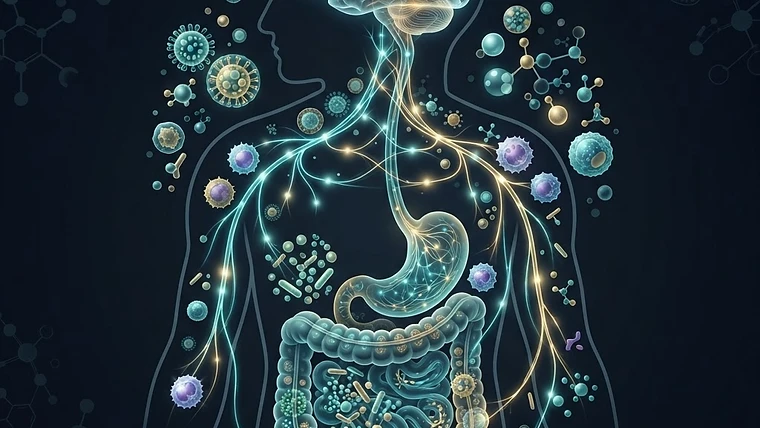
Beyond metabolism, the influence of the gut environment extends to the brain. The gut-brain axis is a bidirectional communication network that links the intestinal microbiome, the immune system, and the central nervous system. When the gut environment is disrupted—whether through dysbiosis, dietary factors, or the presence of foreign organisms—the resulting immune activation can trigger systemic inflammation.
This systemic inflammation is increasingly linked to neuroinflammation, a condition where immune cells in the brain, known as microglia, become chronically activated. Emerging science explores how this neuroinflammatory state may contribute to cognitive fog, mood disorders, anxiety, and depression. Because parasites can alter the composition of the gut microbiota and influence the production of neurotransmitters, they are becoming a focal point in understanding how gut-level disturbances manifest as behavioral or mental health symptoms.
Metabolic Syndrome and the Parasite Connection
Could the presence of certain organisms influence the risk of metabolic conditions? Systematic reviews have highlighted a complex, often paradoxical relationship. While some studies indicate that certain helminth infections are associated with improved metabolic markers—such as lower fasting blood glucose and improved insulin sensitivity—the reality is highly dependent on the species of the parasite, the stage of infection, and the host's baseline health.
It is critical to note that this is not a simple "good vs. bad" binary. The interaction between a parasite and its host is a dynamic process. In the acute phase of an infection, the body may experience heightened inflammation, while in chronic, established infections, the parasite’s survival strategy may involve dampening the host’s immune response to avoid detection. This "immune education" is what researchers are currently dissecting to understand how it might inadvertently protect against or exacerbate metabolic syndrome.
Navigating the Complexity of Modern Health
As we look at the rise of metabolic and mental health conditions, it is clear that the drivers are multifactorial. Genetics, diet, lifestyle, and environmental exposures all play a role. The emerging research into the parasite-disease connection suggests that we must broaden our view of the human "ecosystem."
Understanding how immune dysregulation, triggered by various environmental factors, impacts our metabolic and mental health is a frontier of modern science. For those interested in a deeper exploration of these systemic connections, the book The Parasite-Disease Connection by James Young, RN, offers a comprehensive look at how these biological threads may be woven together, providing a resource for those seeking to understand the broader context of human health and chronic disease.
Conclusion
While the science is still evolving, the study of parasites and their influence on the immune system provides a unique lens through which to view chronic inflammation. By shifting our focus from merely treating symptoms to understanding the underlying biological communication networks, we may gain new insights into the origins of metabolic and mental health challenges. As always, this field remains a space for ongoing discovery, reminding us that the most profound answers often lie in the complex, hidden interactions within our own bodies.
Frequently Asked Questions
Can parasites cause metabolic syndrome?
Research suggests that the relationship is complex. While some studies indicate that certain parasitic infections may modulate the immune system in ways that influence metabolic markers, others show that chronic inflammation from various sources, including infections, can contribute to metabolic dysregulation. It is a bidirectional and highly variable interaction.
How does the gut-brain axis relate to anxiety and depression?
The gut-brain axis is a communication network linking the gut and the brain. When the gut microbiome is imbalanced or the immune system is activated, it can lead to systemic inflammation. This inflammation can reach the brain, potentially contributing to neuroinflammation, which is increasingly studied as a factor in mood disorders like anxiety and depression.
Is there a link between parasites and diabetes?
Some systematic reviews have observed that individuals with certain helminth infections may show lower fasting blood glucose levels, suggesting a potential role in immune modulation. However, this is an area of active research, and the effects vary significantly based on the parasite species and the host's health status.
What is the role of chronic inflammation in mental health?
Chronic, low-grade inflammation is thought to influence neurotransmitter metabolism and neural circuitry. When the immune system remains in a state of constant activation, it can affect brain function, potentially manifesting as cognitive fog, mood instability, or symptoms of anxiety and depression.
Frequently asked questions
Can parasites cause metabolic syndrome?
Research suggests that the relationship is complex. While some studies indicate that certain parasitic infections may modulate the immune system in ways that influence metabolic markers, others show that chronic inflammation from various sources, including infections, can contribute to metabolic dysregulation. It is a bidirectional and highly variable interaction.
How does the gut-brain axis relate to anxiety and depression?
The gut-brain axis is a communication network linking the gut and the brain. When the gut microbiome is imbalanced or the immune system is activated, it can lead to systemic inflammation. This inflammation can reach the brain, potentially contributing to neuroinflammation, which is increasingly studied as a factor in mood disorders like anxiety and depression.
Is there a link between parasites and diabetes?
Some systematic reviews have observed that individuals with certain helminth infections may show lower fasting blood glucose levels, suggesting a potential role in immune modulation. However, this is an area of active research, and the effects vary significantly based on the parasite species and the host's health status.
What is the role of chronic inflammation in mental health?
Chronic, low-grade inflammation is thought to influence neurotransmitter metabolism and neural circuitry. When the immune system remains in a state of constant activation, it can affect brain function, potentially manifesting as cognitive fog, mood instability, or symptoms of anxiety and depression.